Time Tracker Activation
Led activation and growth system improvement work for Time Tracker SaaS
At a glance
I led four task forces to improve solo and team user activation in the web app, Android app, and browser extension. It involved stakeholder alignment across PM/Eng/Data/Support, framing metrics, conducting UX audits, and prioritization, as well as providing direction for prototyping and validation, achieving measured improvements.

The problem
Product-led growth push made it clear that we were at risk of losing a large share of users before they reached meaningful value, especially in early onboarding and first-week behaviours. The risk was growth efficiency, as lower activation would lead to weaker retention and weaker monetization. At the same time, we had multiple platforms, teams, and definitions (setup/aha/habit) that needed to be aligned to run high-velocity improvements without waste.
The goal
Our goal was building an activation system that clarifies what "good" looks like (success metrics), targets the smallest set of changes that unlock meaningful behaviour shifts, and turns insights into shippable experiments across teams and platforms.
Approach
1. Defined success: I aligned the outcomes and helped translate activation conversations into measurable behaviour ladders, including Setup → Aha → Habit framing and supporting event definitions, and granular early steps tied to retention correlation. This created a shared language so teams could prioritize and make tradeoffs quickly.
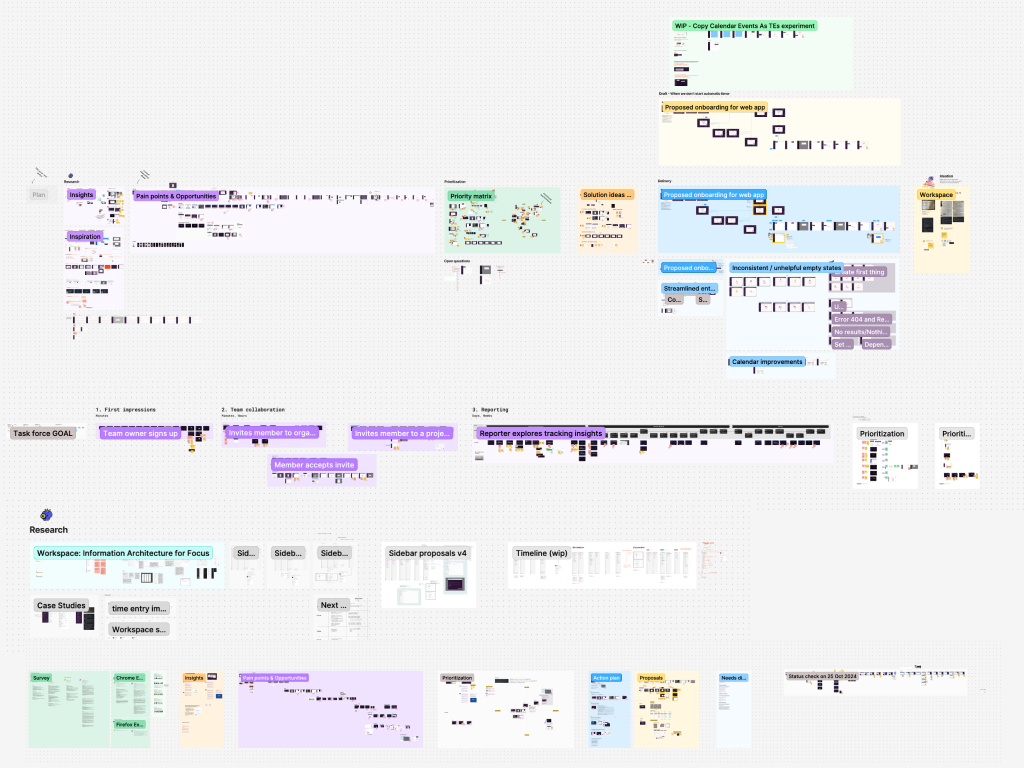
2. Identified leverage: I led end-to-end task force cycles for single-user and team workflows. It included kickoffs and alignment with PMs, engineers, analytics, and support. Conducted UX audits and journey map reviews to expose friction, dead-ends, and missed cues. Then identified high-leverage points involving streamlining onboarding steps, fixing broken touchpoints, improving discoverability and guidance (through empty states, hues, tooltips, confirmations), and creating "instant collaboration" moments for teams through invites and project creation.
3. Shipped experiments: We aimed towards 10% improvements that compound. From identified leverage points, I facilitated prioritization by impact and effort and shaped the high-leverage improvements for inclusion into team experiment pipelines, ready for cycle planning.
Through this process we managed to turn "lots of ideas" into a repeatable system: define success → map journeys → find leverage → ship experiments → measure → iterate
Results
Single-user Activation: number of users who conducted retention-driving behaviours like calendar connection, projection creation, and notification enablement increased by 1303.3%, 52%, and 359% sustained post-launch. However, some other metrics were still stagnating or unclear due to recalibration. Overall, W1 retention increased by nearly 16%.
Team Activation: the primary goal for the team activation metric was achieved and slightly exceeded with 11.54% improvement from the baseline set for the task force. In addition to the primary goal, end-to-end flows involving signup, invites, acceptance, and first collaboration were mapped, and ~63 UX improvements were identified and 9 high-impact items prioritized for the task force scope, including the key improvement driver of the ability to add team members while creating a project that allowed teams to form immediately after acceptance.
Information Architecture: In focused IA sprints, we simplified navigation and improved discovery, achieving aligned approaches between all platform apps: Tracking, Planning, Invoicing, and Admin Console, resulting in faster design delivery and +13% uplift for W4 retention, and +220% for progress overview discoverability in the Planning app.
What I learned
Activation is a systems problem. It's not just "better onboarding screens", but winning through aligning metrics, teams, and decision cadence during continuous improvements. I witnessed how well-placed interventions can out-perform broad conceptual redesigns.
My biggest revelation was observing how clear definitions and visibility into the challenges and goals align teams. Without journey maps and dashboards teams argue, with them – teams ship.